Before you go, see it all live
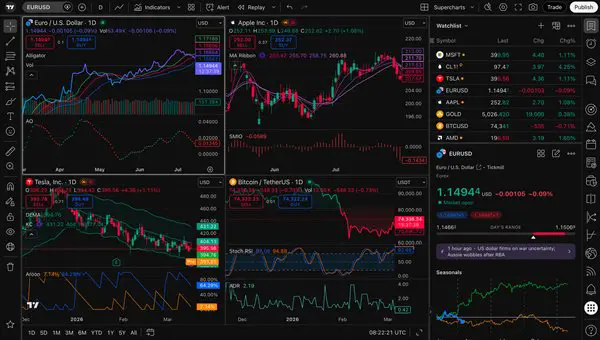
100% Free · No sign-upEvery market on one screen, live and free. Here is what is waiting on the dashboard:
- Panels that rotate through more markets on their own
- An info icon on every instrument with a plain-English explainer
- Turn any card into a live news feed that stays put across refreshes
- A knowledge hub of in-depth market guides to sharpen your edge
When people say "the 10-year yield", they almost always mean the nominal yield: the headline rate on a normal Treasury. But gold, growth stocks and central bankers pay closer attention to a second number, the real yield.
The short answer: the nominal yield is what a Treasury pays in dollars. The real yield is what an inflation-protected Treasury (a TIPS) pays above inflation. The gap between them, nominal minus real, is breakeven inflation: the inflation rate the bond market is pricing in. Gold pays no interest, so the real yield is the return you give up to hold it, which is why gold tends to follow the real yield and not the nominal one.
Both yields are on the free dashboard. This guide explains the difference, works an example with round numbers, and shows how to read the two together.
Educational only, not financial advice. The link between real yields and gold or stocks is a tendency, not a rule.
Right now
| Measure | Reading | What it is |
|---|---|---|
| 10-year Treasury yield (nominal) | 5.31% | The headline rate on a normal 10-year Treasury |
| 10-year real yield (TIPS) | 2.95% | What the 10-year TIPS pays above inflation |
| Breakeven inflation | 2.36% | Nominal minus real: the inflation rate priced in |
| Gold | $4,191.30 (+0.83%) | The asset that tends to follow the real yield |
Right now the 10-year Treasury pays 5.31%, the 10-year TIPS pays 2.95% above inflation, and the difference, about 2.36% a year, is the inflation rate the bond market is pricing in over the next ten years.
The two yields are daily Federal Reserve series, so they can be a day behind the gold price. These values are from when this page was generated; the dashboard updates live.
The two yields in one table
| Nominal yield | Real yield | |
|---|---|---|
| What it is | The yield on a normal Treasury, such as the 10-year | The yield on an inflation-protected Treasury (TIPS) of the same maturity |
| Inflation | Includes the market's expected inflation | Strips expected inflation out |
| Payout | Fixed coupons and a fixed face value | Principal rises with inflation; the coupon is paid on the adjusted principal |
| Can it be negative? | Almost never | Yes, when inflation is expected to exceed the yield |
| Source on the dashboard | US 10Y (Federal Reserve daily series) | Real 10Y (Federal Reserve daily series) |
| Who watches it | Mortgage lenders, bond investors, anyone pricing borrowing costs | Gold investors, growth-stock investors, central bankers |
| Relationship | Nominal is about real plus expected inflation. Subtract one from the other to get breakeven inflation. | |
Breakeven inflation: a worked example
A hypothetical example with round numbers: the 10-year Treasury yields 4.20% and the 10-year TIPS yields 1.90% above inflation. Breakeven inflation is the difference: 2.30% a year. Then ask which bond wins, depending on what inflation actually averages over the next ten years:
| Inflation over ten years | Treasury return | TIPS return | Winner |
|---|---|---|---|
| 1.5% a year | 4.20% | 1.90% + 1.5% = 3.40% | Treasury |
| 2.3% a year (breakeven) | 4.20% | 1.90% + 2.3% = 4.20% | Tie |
| 3.0% a year | 4.20% | 1.90% + 3.0% = 4.90% | TIPS |
This is a simplification: the real return is approximate, and the market's breakeven also contains a premium for inflation risk and for the TIPS market being smaller and less liquid. It is a market-implied expectation, not a forecast. What it gives you is a live reading of how worried the bond market is about inflation, from two numbers you can see on the dashboard.
In a taxable US account, the yearly inflation adjustment on a TIPS is taxed as income even though you do not receive it until maturity, which is why TIPS are often held in tax-advantaged accounts. For the other side of the bond choice, see Dividend Stocks vs Bond Yields.
Why gold and growth stocks follow the real yield
Gold. Gold pays no interest. The real yield on a safe bond is therefore the return you forgo by holding gold instead: the opportunity cost. When real yields rise, holding gold costs more and it tends to come under pressure. When real yields fall or turn negative, it costs little and gold tends to be supported. It is also why gold can rise on the same day the nominal yield rises: if inflation expectations rise faster, the real yield falls.
Growth stocks. A company whose profits are far in the future is worth less when the rate used to discount those profits rises. The real yield is the cleanest version of that rate, so long-duration growth stocks tend to be sensitive to it.
Treat both links as tendencies, not laws. The gold relationship has weakened at times, including in years when central banks were heavy buyers, and stocks respond to earnings as much as to rates. The broader mechanics of rates, the dollar and commodities are in How Interest Rates Affect the Markets.
Reading the two together
| What you see | What it can mean |
|---|---|
| Nominal up, real up, breakeven flat | The market expects tighter policy or stronger growth, not more inflation. Often a headwind for gold and growth stocks. |
| Nominal up, real flat or down, breakeven up | Inflation worries are driving the move. Gold is often supported, because the real yield is not rising. |
| Nominal down, real down | Markets expect lower rates. Usually a tailwind for gold and long-duration stocks. |
| Nominal down, real up, breakeven down | A disinflation or growth scare: inflation expectations are collapsing faster than rates. It happened in late 2008. |
These are patterns, and any single day can break them. The point is that the nominal yield alone cannot tell you why it moved. The real yield and the breakeven can.
How to use them
- When the 10-year yield moves, check the real yield. If both moved together, the move is about growth and policy. If only the nominal moved, it is about inflation.
- Check gold against the real yield, not the nominal. A falling real yield is the supportive backdrop; a rising one is the headwind.
- Watch the breakeven for inflation fear. A fast rise means the bond market is pricing in more inflation.
- Keep the lag in mind. The yields on the dashboard are daily Federal Reserve series and can be a day behind prices that update by the minute, such as gold.
The yield curve, the Fed funds rate and the dollar sit next to these on the dashboard. The Financial Markets Guide explains each one.
The bottom line
The nominal yield is what a Treasury pays. The real yield is what it pays after inflation, and the gap between them is breakeven inflation. Gold and growth stocks care most about the real yield, because it is the true cost of money and the return you give up by holding an asset that pays nothing today. Look at both numbers together: the nominal tells you where borrowing costs are, the real tells you what that means for gold and growth, and the breakeven tells you whether inflation is the reason.
Common questions
What is the difference between real and nominal yield?
The nominal yield is the headline rate on a normal Treasury bond, such as the 10-year Treasury yield. The real yield is what an inflation-protected bond (a TIPS) pays above inflation. The nominal yield contains the market's expected inflation, and the real yield strips it out. In simple terms, nominal is about real plus expected inflation.
What is breakeven inflation?
Breakeven inflation is the nominal Treasury yield minus the TIPS real yield of the same maturity. It is the average annual inflation over that period at which a normal Treasury and a TIPS would give the same return. If inflation turns out higher than the breakeven, the TIPS wins; if lower, the normal Treasury wins. It is a market-implied expectation, not a forecast.
Why does gold fall when real yields rise?
Gold pays no interest, so the real yield on a safe bond is the return you give up by holding it. When real yields rise, that opportunity cost goes up and gold tends to come under pressure. When real yields fall or turn negative, holding gold costs little and it tends to be supported. The link is a tendency, not a law, and it has weakened at times, including in years of heavy central bank buying.
What is a TIPS?
A TIPS is a Treasury Inflation-Protected Security. Its principal rises with consumer price inflation, and its fixed coupon is paid on the adjusted principal, so both the interest and the amount returned at maturity keep up with inflation. In a taxable US account the yearly principal adjustment is taxed as income, which is why TIPS are often held in tax-advantaged accounts. This is educational, not financial advice.
Can the real yield be negative?
Yes. When the market expects inflation to exceed the nominal yield, the real yield is below zero: lenders accept a loss of purchasing power. The 10-year real yield was negative through most of 2020 and 2021, which was a supportive backdrop for gold and long-duration growth stocks. Positive real yields since then raised the bar for both.
How do I calculate a real yield?
A quick approximation is the nominal yield minus expected inflation. The market's own version is the TIPS yield, which is published directly, so you do not need to estimate it. The exact relationship is (1 + nominal) divided by (1 + inflation) minus 1, but at normal rates the simple subtraction is close.
Where can I see the real and nominal yields live?
The Global Markets Dashboard at gmdmarkets.com shows the 10-year Treasury yield and the 10-year real yield side by side in the rates section, free. The page you are reading also prints the latest values and the implied breakeven inflation in its Right now table.
Explore the markets
Partner platforms (sponsored). We may earn a commission if you sign up. Not a recommendation or financial advice.



This guide is free to use, supported by affiliate partnerships. Some broker and tool links are sponsored, and we may earn a commission if you sign up, at no extra cost to you. This never affects what we cover or how we explain it.