Before you go, see it all live
100% Free · No sign-upEvery market on one screen, live and free. Here is what is waiting on the dashboard:
- Panels that rotate through more markets on their own
- An info icon on every instrument with a plain-English explainer
- Turn any card into a live news feed that stays put across refreshes
- A knowledge hub of in-depth market guides to sharpen your edge
Almost every beginner asks the same question in the wrong order. They ask which indicator to use, which platform to open, which stock to buy. The traders who survive ask a different first question: how much am I willing to lose on one trade, and how will I know if I am any good?
The short answer: pick a trading style that fits the hours you actually have, learn risk control before entries, trade one market and one setup until you have a real sample size, journal every trade, and only then scale. The capital problem at the end (needing a large account to make a living) is the one a proprietary trading firm can solve for you, once you already have an edge worth funding.
This guide walks that path in order. If you are still deciding whether trading is for you at all, read trading vs gambling and the trader or gambler self-check first. To watch the markets you will be trading, the free live dashboard is open and needs no signup.
Educational only, not financial advice. Trading carries risk of loss, including the loss of your entire deposit. Firms and books named are examples, not recommendations.
The path, in seven steps
The order matters more than the content of any single step. Everything that keeps you alive in the market comes before everything that makes money, because the second is worthless without the first.
- Pick your trader type. Choose a holding period that fits the hours and capital you actually have. Most beginners fail because they picked a style that does not fit their life, not because they picked bad trades. See the comparison table →
- Learn risk before entries. Decide your maximum loss per trade (commonly 1%) and per day before you study a single chart pattern. Position size is calculated from the stop distance, never chosen by feel. The survival basics →
- Choose one market and one setup. Trade a single instrument and a single repeatable pattern until you have a few hundred observations. Switching restarts your sample size every time, and depth on one asset is the only real counter to institutional breadth. Why depth beats breadth →
- Keep a written trade journal. Record entry, exit, stop, size, reason and emotional state for every trade. It is the only tool that separates a good decision from a lucky outcome. What to record →
- Test the edge, then trade it tiny. Get an expectancy figure over at least 100 trades, then go live at the smallest size your broker allows, because real money changes behavior in ways simulation cannot. The worked example →
- Prove consistency before adding capital. Scale only after several months of positive expectancy and controlled drawdown, measured in R multiples rather than currency. One good month proves nothing. Going professional →
- Only then consider a funded evaluation. A prop firm lets you trade meaningful size without risking savings, but pass rates are in the single digits. It is a test of an edge you already have, not a way to acquire one. Read the warning first →
Steps 1 to 4 cost nothing and decide whether you survive. Steps 5 to 7 decide whether you earn. Beginners who fail almost always started at step 5. If step 2 already sounds like something you would skip, section 08 is written for you and it is not a consolation prize.
- 01🧭 The six trader types compared
- 02🧱 The basics that decide survival
- 03🔬 Become the expert on your asset
- 04🎯 Finding and testing an edge
- 05📈 Leveling up to professional
- 06🏦 Prop firms: trade size without risking savings
- 07🔍 How to pick a prop firm
- 08⚠️ The mistakes that end most accounts
- 09🏆 What winning does to you
- 10🤖 Competing with algorithms and AI
- 11🤝 Not for you? The honest alternatives
- ?❓ Common questions
The six trader types compared
Before anything else, decide what kind of trader your life allows you to be. This single choice eliminates most beginner frustration, because a person with a full-time job trying to scalp the open is not fighting the market, they are fighting their calendar.
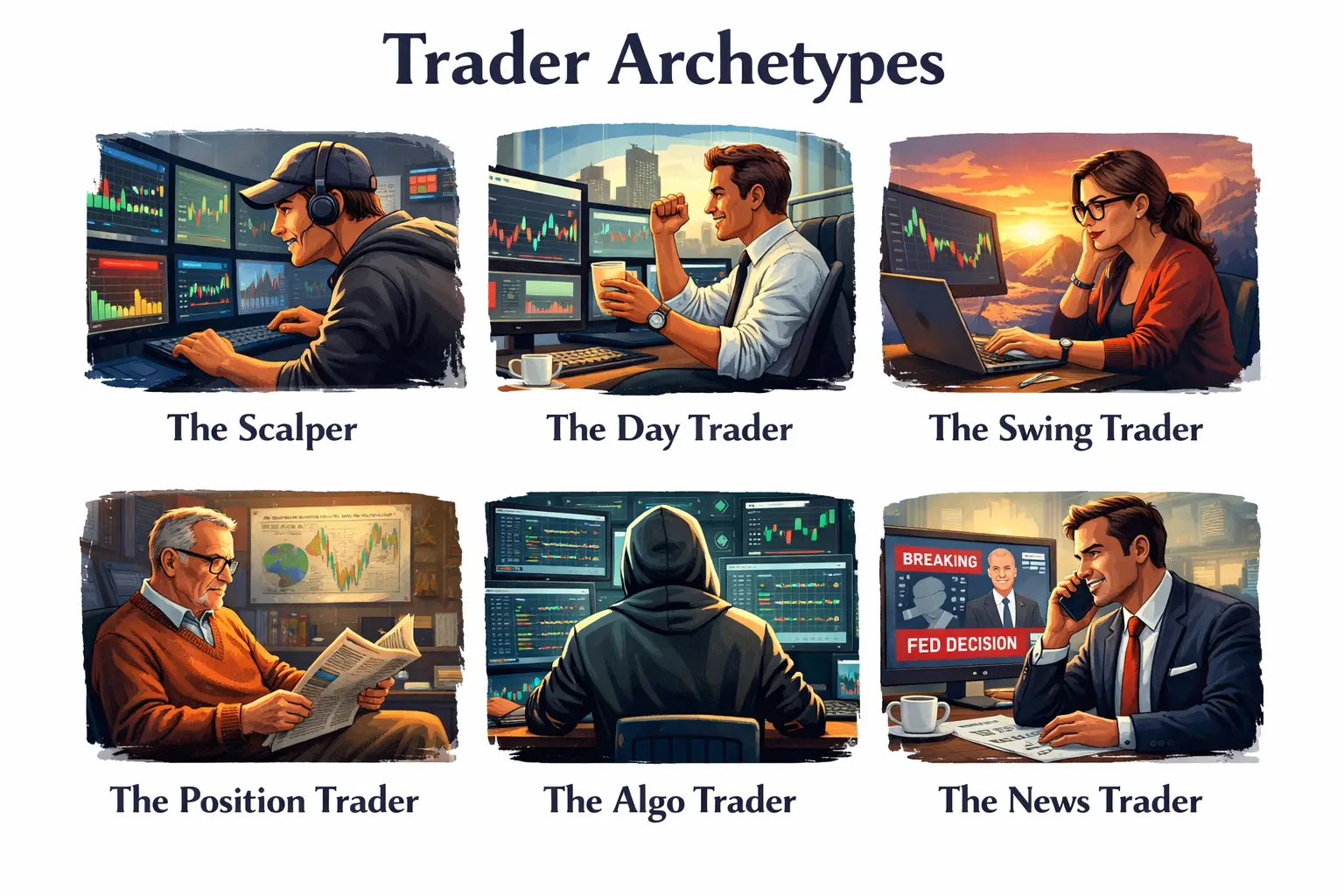
| Type | Holding period | Screen time | Realistic starting capital | Core skill | Main risk |
|---|---|---|---|---|---|
| Scalper | Seconds to minutes | Full session, total focus | High, or a funded account | Execution speed, order flow reading | Costs and spread eat the edge; burnout |
| Day trader | Minutes to hours, flat by close | Full session | Meaningful; US pattern day trader rules apply above 3 trades in 5 days | Intraday structure, discipline under speed | Overtrading; the style with the highest failure rate |
| Swing trader | Days to weeks | Under an hour a day | Modest; the most job-compatible style | Patience, technical and catalyst reading | Overnight and weekend gap risk |
| Position trader | Weeks to months | A few hours a week | Modest | Trend and macro reading | Long dead periods; conviction turning into stubbornness |
| Algorithmic trader | Any, automated | Front-loaded into research | Varies; the cost is time and skill | Statistics and programming | Curve fitting a backtest that never repeats live |
| News trader | Seconds to days, around an event | Bursts: the economic calendar sets the schedule | Modest, but needs fast execution and tight spreads | Reading the release against what was already priced in | Slippage and spread blowouts in the first seconds; being right on the news and still losing |
| Investor (for contrast) | Years | Hours per quarter | Any amount, compounding does the work | Valuation, temperament | Confusing a losing trade with a long-term hold |
And the seventh type, the one nobody chooses on purpose: the gambler. It is missing from the table deliberately, because gambling is not a trading style, it is what any of the six above becomes once the process is removed. A scalper without a stop, a swing trader who moves it, a position trader holding a loser and calling it conviction: all six styles have a gambling version, and it looks identical from the outside. The difference is not the timeframe or the instrument, it is whether you can state your edge, your risk per trade and your exit before you enter. If you are not sure which side of that line you are on, the 90-second self-test scores it, and trading vs gambling explains the distinction in full.
The honest recommendation for a beginner: start as a swing trader, whatever you eventually want to be. It gives you time to think between decisions, it does not require you to be at a screen during market hours, and every mistake happens slowly enough that you can see it. Day trading compresses the same lessons into a timeframe where you cannot learn from them.
The basics that decide survival
Notice that none of these are about picking winners. Trading is a game where you can be right less than half the time and still make money, and be right most of the time and still go broke. What separates the two is entirely on this list.
Risk per trade comes first
Decide the maximum percentage of the account you will lose on any single trade before you look at a single chart. The common convention is 1 percent, and a beginner has no reason to exceed 2. At 1 percent, ten losses in a row cost you about a tenth of the account and you are still trading. At 10 percent, the same losing streak ends your account and your career. This is the whole reason professionals talk about risk before they talk about profit.
"Don't focus on making money; focus on protecting what you have."
Paul Tudor Jones
Position size is calculated, never chosen
Your size follows from two numbers you already know: the money you are risking, and the distance to your stop. Not "a few hundred because I feel good about this one." When the stop is far away, the position must be smaller. This one arithmetic habit converts a gambler into a trader.
Position size = (account × risk %) ÷ (entry price − stop price)
Worked through: a $10,000 account risking 1% puts $100 on the line. You want to buy at $50 with a stop at $48, so each share can lose you $2. That is $100 ÷ $2 = 50 shares, a $2,500 position. Move the stop to $45 and the same $100 risk allows only 33 shares. The risk never changes; the size absorbs the difference.
The stop is decided before entry
Every position needs a price at which the idea is proven wrong, chosen while you are calm and have no money on the line. A stop moved further away mid-trade is not risk management, it is hope with extra steps. Traders rarely die from a bad entry; they die from a loss they refused to take.
One market, one setup
Trade a single instrument and a single repeatable pattern until you have several hundred observations of it. Beginners switch markets and strategies every few weeks, which resets the sample size to zero each time and guarantees they never discover whether anything they do works. Depth beats breadth for the first year, without exception.
The journal is the actual curriculum
Record every trade: entry, exit, stop, size, the reason you took it, and how you felt. Then review it weekly. The journal is the only tool that separates a good decision from a lucky outcome, and that distinction is the entire skill. A trader without a journal is not practicing, they are just placing bets and remembering the good ones.
Think in R, not in currency
Express every result as a multiple of the amount you risked. A trade that made twice your risk is +2R whether that was $40 or $4,000. This strips the emotion out of reviewing your performance, makes results comparable across account sizes, and is the language every funded desk uses.
Understand the cost of leverage
Leverage does not increase your edge, it multiplies whatever your process already produces, including the losses and including the mistakes. Regulatory disclosures from European brokers consistently show 70 to 80 percent of retail accounts losing money on leveraged products. Leverage is why that number is so high. It is a tool for a trader who is already consistent, not a shortcut for one who is not.
Become the expert on the asset you trade
Institutions win on breadth: a model can watch ten thousand instruments at once and you cannot. Depth is the counter. Nobody at a fund is paid to know one mid-cap or one currency pair the way a person can know it after a year of watching it every day. Trading a handful of things you know deeply beats trading fifty you know vaguely, and it is the only competitive position genuinely available to a small trader.
Knowing an asset means far more than knowing what the company does. It means knowing how it behaves:
Its personality
Does it trend for weeks or chop and mean-revert? What is a normal daily range, and what counts as an unusually large day? Does it gap at the open? Does volume dry up in the afternoon? Two instruments with identical charts can require completely different handling, and this is knowledge you acquire only by watching one thing repeatedly, never from a book.
Its levels, and how it treats them
The 50-day and 200-day moving averages matter less as predictors than as places where you can observe behavior. The useful question is not "is price above the 200-day," it is "what does this specific asset usually do when it gets there?" Some names bounce off the 50-day repeatedly for years; others slice through it as if it were not there. A golden cross (50-day crossing above the 200-day) or a death cross is a slow, widely reported signal, and its real value is as context for the regime you are trading in, not as an entry trigger. The same applies to prior highs and lows, round numbers and the range of the last big move: what matters is your own record of how your asset has reacted at each.
One caveat worth carrying: these levels are watched by everyone, so their effect is partly reflexive. Price reacts at the 200-day partly because a great many participants are acting on it, which also means the reaction can be brief and violent rather than reliable.
Its calendar and its drivers
Every asset has scheduled events that dominate everything else on the days they land: earnings and guidance for a stock, FOMC and CPI for indices, inventory reports for oil, central bank meetings for a currency pair, halvings and ETF flows for Bitcoin. Knowing your asset means knowing these dates before they arrive, so you are never surprised into a loss by an event that was on a public calendar for months. It also means knowing what actually moves it: gold responds to real yields and the dollar, big tech to rate expectations, miners to the underlying metal with leverage. You can watch most of these relationships live on the dashboard, and the how markets move each other guide maps the main ones.
Take profits deliberately
Most guides obsess over entries and stops and go quiet on exits, which is strange, since the exit determines what you actually earn. Decide the target before you enter, in the same calm moment you set the stop, and express it in R: a setup risking 1R to make 2R is a different proposition from one risking 1R to make 0.5R, no matter how attractive the chart looks.
Three approaches, all legitimate, and knowing your asset is what tells you which fits: a fixed target at a level the asset historically struggles past; a partial exit, taking some off at the first target and letting the rest run with the stop moved to breakeven, which trades some upside for a much easier psychological ride; or a trailing stop for instruments that genuinely trend, which gives back part of the move on every exit but catches the rare large winner. What is not legitimate is having no plan and deciding while the position is open and your judgment is compromised.
Reevaluate, and separate the two kinds of exit
There are two distinct reasons to close a trade, and beginners blur them. One is that price hit your stop: the trade was wrong and the exit is automatic. The other is that your thesis broke while price has not yet moved, which is a judgment call and requires you to have written the thesis down in the first place. If you entered because a stock was breaking out on strong volume into an earnings cycle, and volume collapses while the breakout stalls, the reason you are in the trade has expired even if your stop is untouched. Leaving is correct.
Build the review into a routine: a weekly pass over open positions asking one question per trade, "would I enter this today, knowing what I now know?" If the answer is no, you are holding out of inertia or hope, which are not strategies. This is also where the asset expertise pays off, because judging whether behavior is normal noise or a genuine character change is only possible if you know what normal looks like.
Finding and testing an edge
An edge is a repeatable situation where your expected outcome is positive. It is not a feeling, and it is not an indicator. It is a number you can compute from your own records:
Expectancy = (win rate × average win) − (loss rate × average loss)
If that figure is positive over a large enough sample, you have something worth trading and worth funding. If you cannot compute it, you do not yet know whether you have a strategy or a habit.
Worked example. Take a trader who is wrong more often than right, and see why that does not matter:
| Input | Value | Where it comes from |
|---|---|---|
| Win rate | 40% (40 wins in 100 trades) | Counted from the journal |
| Average win | $300 | Total won divided by number of wins |
| Average loss | $150 | Total lost divided by number of losses |
| Expectancy | (0.40 × $300) − (0.60 × $150) = +$30 per trade | The formula above |
| Over 100 trades | +$3,000 | Expectancy × number of trades |
This trader loses 6 times out of every 10 and still makes money, because the wins are twice the size of the losses. That is the entire game in one table. It is also why "what is your win rate?" is the wrong question: a 70% win rate with losses three times bigger than the wins is a losing system.
In R terms the same result reads: (0.40 × 2R) − (0.60 × 1R) = +0.2R per trade. Every trade you take is worth a fifth of what you risk, on average. Now the only questions left are how many trades you can find and whether you can follow the plan on all of them.
- Form a hypothesis. Something specific and testable: a defined setup, a defined entry trigger, a defined exit. "Buy strong stocks" is not testable. "Buy the first pullback to the rising 20-day average after a 52-week high, stop below the pullback low" is.
- Test it over at least 100 trades. Backtest on historical data or forward-test on paper. Fewer than about 100 observations and you are reading noise, not signal.
- Beware curve fitting. A strategy tuned until it looks perfect on past data usually describes that data rather than the market. The more parameters you optimized, the less you should trust it. Test on a period you did not tune on.
- Then trade it live at minimum size. Real money changes behavior in ways no simulator reproduces. The purpose of this stage is not profit, it is discovering what you do under pressure while the cost of finding out is trivial.
"Win or lose, everybody gets what they want out of the market."
Ed Seykota, in Market Wizards
Leveling up to professional
The gap between a competent hobbyist and a professional is not a better strategy. It is consistency, capital, and treating the activity as a business rather than a pastime.
Consistency is measured, not felt
Before you scale anything, you want several consecutive months of positive expectancy with drawdown inside the limits you set for yourself. One good month proves nothing; markets have regimes, and a strategy that only works in a trending market will hand back everything when the regime changes. Professionals track the process metrics (adherence to plan, average R, maximum drawdown) rather than the profit and loss, because the process is the part they control.
Build the routine
A professional session has a shape: a pre-market review of levels and scheduled events, a defined window for execution, and a post-session journal entry. The routine exists to make decisions in advance, so that the moment of maximum emotion is not also the moment of maximum discretion. Watching the macro backdrop (rates, the dollar, sector rotation) is part of the pre-market review, which is what the live dashboard and the markets guide are built for.
Solve the capital problem honestly
Here is the arithmetic nobody enjoys. A genuinely good trader might return 20 to 40 percent a year. On a $5,000 account that is $1,000 to $2,000 annually, which is not a living. To earn a modest full-time income from your own capital, you need a six-figure account. This is the wall that every skilled but undercapitalised trader hits, and there are exactly three ways through it: save for years, join an institution, or trade someone else's capital through a proprietary trading firm.
Treat it as a business
Track costs, commissions and spread as a business expense; understand the tax treatment of trading in your jurisdiction before the tax year ends, not after; and keep trading capital separate from living expenses. A trader paying rent from a volatile account will make position-sizing decisions driven by the calendar rather than the setup, which is the fastest way to destroy an otherwise sound process.
Prop firms: trade size without risking your savings
A proprietary trading firm lets you trade the firm's capital and keep a share of the profits. The modern online version works as an evaluation: you pay a fee, trade a simulated account, and must reach a profit target without breaching a daily loss limit or a maximum drawdown. Pass, and you get a funded account with a profit split that is commonly 80 to 90 percent in the trader's favor.
Read this before you pay for any challenge. Published pass rates for prop firm evaluations are in the single digits. On the numbers, the most likely outcome of buying a challenge is that you lose the fee and receive nothing. Firms earn from the profit split and from the fees of everyone who fails, which is why their advertising targets beginners rather than proven traders.
A challenge is not income, and it is not a job. Never pay for one with money you need, never fund one with credit or borrowed money, and never buy a second because the first was "so close." If you cannot state your edge, win rate, average win and average loss from your own journal, you are not ready, and waiting three months will cost you far less than three failed challenges.
Treat the fee as tuition you will probably not get back. If that framing makes the purchase feel wrong, that is the correct response, and it is the reason to keep building on a small live account first.
Why it is genuinely useful
For a beginner, the value is not the money. It is this: an evaluation is the cheapest realistic test of whether your process survives pressure and rules.
Risking $500 of your own money teaches you very little, because the consequence is small enough to shrug off. A challenge with a hard daily drawdown limit and a profit target imposes the same constraints a professional desk imposes.
It reveals whether you can follow a plan when breaking one rule ends the account. That feedback is worth the fee even if you fail, provided you treat the fee as tuition.
The part the ads leave out
Published pass rates for evaluations sit in the single digits, and many who pass later breach a rule on the funded account. The business model matters here: firms earn from the profit split and from the evaluation fees of everyone who does not pass, which means their marketing is aimed at people statistically unlikely to succeed. None of this makes prop firms a scam, and the reputable ones pay out reliably and publish their numbers. It does mean the fee is a cost of testing yourself, not an investment with an expected return.
The sequence that actually works: develop a documented edge on a small live account first, then take an evaluation to trade that same edge at size. Traders who buy a challenge as their way of learning to trade are paying the tuition without attending the class. If you cannot state your expectancy from your own journal, you are not ready for an evaluation yet, and waiting three months will cost you less than three failed challenges.
One structural note in the trader's favor: because the capital is the firm's, the worst case is the fee. You cannot lose more than you paid, there is no margin call reaching your bank account, and no leveraged position can end up owing money. For someone testing whether they can handle size, that asymmetry is the real argument.
How to pick a prop firm
The offers look similar and differ in exactly the places that decide whether you pass. Check these before the marketing:
| What to check | Why it decides the outcome |
|---|---|
| Asset range | A firm covering indices, forex, commodities, stocks and crypto lets you trade the setup you actually know, and lets you keep trading when your market goes quiet. A narrow firm forces you into unfamiliar instruments to hit the target, which is how challenges are failed. FTMO is the common reference point here for breadth. |
| Daily drawdown rule | The single most common cause of failure. Check whether it is measured on closed equity or intraday balance, and whether it trails. An intraday trailing limit can end your account on an open position that later recovers. |
| Profit target vs time limit | A 10 percent target with no time pressure is a very different task from the same target in 30 days. Time limits push traders into oversized positions near the deadline. Prefer firms with no minimum trading days pressure or generous windows. |
| Profit split and payout record | 80 to 90 percent is the market rate. More important than the headline number is whether the firm demonstrably pays: look for published payout reports and independent trader reports over multiple years, not testimonials on the firm's own page. |
| News and weekend rules | Many firms restrict holding through high-impact news or over the weekend. If you are a swing trader, a weekend-holding ban is disqualifying, and it is usually buried in the rules rather than the sales page. |
| Regulation and track record | Prefer firms operating for several years with a clear legal entity and transparent terms. The sector has seen abrupt closures; longevity is the best available proxy for solvency. |
| Free retry or reset cost | Many firms offer a free retry if you miss the target without breaching drawdown. This materially changes the real cost of an attempt. |
Read the full rulebook before paying, especially the drawdown calculation method. The rules, not the strategy, are what most challenges turn on.
The mistakes that end most accounts
- Revenge trading. Trying to win a loss back immediately, at larger size. This single behavior destroys more accounts than any bad strategy.
- Moving the stop. Widening a stop to avoid taking a loss converts a small planned loss into an unplanned large one.
- Averaging down into a loser. Adding to a losing position to improve the average price increases risk exactly when the thesis is failing.
- Overtrading out of boredom. Most of the time the market offers nothing. Sitting out is a position.
- Strategy hopping. Abandoning a system after a normal losing streak, guaranteeing you never see any edge play out over a real sample.
- Risking money you need. Trading rent money forces bad decisions on a schedule the market does not care about.
- Paying for signals and gurus. If someone could reliably predict the market, selling a subscription would be a poor use of their time. Learn the process instead.
"There is nothing new in Wall Street."
Jesse Livermore, in Reminiscences of a Stock Operator
What winning does to you
Every list above is about what losing does to people, and every beginner is warned about it. Almost nobody is warned about the other half. A good run changes your relationship with risk quietly, and it arrives at the exact moment you finally have something worth giving back.
A winning streak is not new information
Three good weeks feel like evidence that the rules were training wheels. They are not. Inside any system with a positive expectancy, runs of winners are expected, and a streak tells you almost nothing you did not already know from the sample as a whole. A strategy with a 45% win rate produces four wins in a row reasonably often. That is arithmetic, not skill returning.
What the streak does change is how risk feels, and feelings about risk are what set position size.
Size creep is the mechanism
Nobody decides to abandon risk management. The sequence is smaller than that: 1% per trade, then a setup that looks obviously better than usual, so 2%, and by the fourth of those it is 3% and it no longer feels like a decision at all.
The give-back is arithmetic too. A month of disciplined 1% trades can be erased by one trade at three times normal size. That is why the damage lands on competent traders rather than beginners: a beginner has nothing to give back.
Find your own triggers, then write the rule
This is what the journal in section 02 is actually for. Recording profit and loss tells you what happened; recording what you felt and why you acted tells you when you are dangerous. Read back through your worst trades and look at what preceded each one rather than at the trade itself. The pattern is usually embarrassingly consistent.
A rule written calmly, in advance, holds. A rule invented in the middle of a trade never does. Common triggers and the structure that survives them:
| Trigger | What it feels like at the time | A rule written before it happens |
|---|---|---|
| A win much larger than usual | Confidence, and a sense that the next one is obvious | No new position for a set period after closing an outsized winner |
| A winning streak | The rules feel like they are holding you back | A maximum position size that cannot be exceeded regardless of conviction |
| A loss you did not take cleanly | Urgency, and a need to make it back today | A hard daily loss limit that ends the session, not the trade |
| Watching someone else's winner | Missing out, and that your approach is too slow | Only setups on your written list are tradeable, wherever the idea came from |
| Checking the account balance mid-session | The number becomes the decision instead of the chart | Positions are managed in R, with the balance reviewed only after the close |
| Coming back from a break | Impatience to be in something | A minimum number of observed sessions before sizing back up |
Your triggers may be none of these. That is the point: the list is a prompt for reading your own journal, not a diagnosis. A trader who knows their two real triggers and has one written rule for each is further along than one who has read every book on discipline.
This is why a process beats another course
A course teaches somebody else's setups, tested on somebody else's temperament, in a market that has since moved on. It cannot tell you that you size up after wins, or that you trade badly on Friday afternoons, because it has never met you. Those facts are in your own journal and nowhere else, and the rules built from them are the part of a trading approach that cannot be bought.
Competing with algorithms and AI traders
Every beginner eventually asks the same worried question: if hedge funds run machine learning models and high-frequency firms trade in microseconds, what chance does a person with a laptop have? It deserves a straight answer rather than the usual reassurance.
Who is actually on the other side
| Participant | Timeframe | How they make money | Do you compete with them? |
|---|---|---|---|
| High-frequency market makers | Microseconds to seconds | Capturing the bid-ask spread and tiny inefficiencies, millions of times | No, unless you scalp. They are your counterparty, not your rival. |
| Institutional quant funds | Days to months | Statistical models over thousands of instruments, with teams of PhDs and data nobody sells you | Partly, on the same timeframes, but with different constraints |
| Discretionary institutions | Weeks to years | Research, access and size | Yes, and they are slower than you |
| Retail bots and AI tools | Any | Mostly they do not; the sellers make money on subscriptions | No. Most are noise. |
| Other retail traders | Any | Most lose | Yes, and this is realistically your competition |
The honest part: three races you cannot win
You will never beat a machine on speed, and firms spend millions on microwave towers and colocated servers for advantages measured in microseconds. You will never beat one on data, since institutions buy satellite imagery, credit card aggregates and shipping records you cannot access. And you will never beat one on breadth, because a model can monitor ten thousand instruments while you can follow a handful. Anyone selling you a method to "beat the algorithms" on those three axes is selling a fantasy.
The part nobody tells beginners: being small is an edge
Every advantage below exists because you are small and answer to nobody. A fund cannot copy them, and no amount of compute fixes them:
- You can do nothing, indefinitely. A fund charging fees must stay invested; sitting 80% in cash for four months gets a manager fired. You can wait for the one setup you understand. In a game of expectancy, the right to skip bad trades is worth more than most indicators.
- You can trade sizes they cannot. A fund moving $500m cannot touch a small cap without becoming the price. Whole categories of opportunity are invisible to them because they are too small to matter, and they are exactly the right size for you.
- You have no redemption risk. Funds are forced to sell at the worst moment because investors withdraw after drawdowns. Nobody can force you out of a correct position at the bottom.
- You have no benchmark and no quarter. You are not judged against an index every three months, so you are never pushed into a crowded trade to avoid career risk. That pressure drives a surprising amount of institutional behavior.
- You can change your mind instantly. No investment committee, no mandate, no risk officer. You can be flat in ten seconds.
Notice that none of these are about being smarter. They are about being unconstrained, and they only convert into money if you actually use them, which means sitting out. The trader who takes 300 mediocre trades a year has thrown away the single biggest advantage they had.
What AI genuinely changed
Two things, honestly. Simple technical patterns decay faster than they used to, because anything expressible in a few rules gets found and arbitraged quickly, so a basic indicator crossover published in a book is unlikely to still carry an edge. And news reaction is now effectively instant, so trading a headline you read on a feed means you are last in a queue that started with a machine parsing the release.
What did not change is that markets are still driven by humans making decisions under uncertainty, in size, on timeframes where speed is irrelevant. Fear and crowding still produce the same patterns they did a century ago, because the participants are still people.
Where that leaves you
- Pick a timeframe where speed does not decide the outcome. Swing and position trading are structurally safer ground for a person than anything intraday. This is the single most useful conclusion in this section.
- Compete on judgment and patience, not reaction. Your edge is the trades you decline and the ones you are willing to hold, neither of which a mandate-bound manager can do freely.
- Use AI as a research assistant, not a signal generator. It is genuinely good at summarizing filings, checking your reasoning, structuring a journal and helping you backtest. It is not good at telling you what to buy, and a model that could would not be sold to you.
- Treat every "AI trading bot" as a scam until proven otherwise. This is now the most common retail trading fraud. The tell is always the same: a promised return, a track record you cannot verify, and a subscription or deposit. A system that reliably printed money would be funded privately, not marketed to beginners.
For a fuller picture of how the machines actually operate in markets, see how AI is changing trading.
If trading is not for you, that is a finding, not a failure
Almost every guide like this one assumes you should become a trader. Most people should not, and reaching that conclusion early is worth more than any strategy on this page. Trading asks for a specific temperament: the ability to follow a rule that is currently costing you money, to sit out for weeks, and to be wrong repeatedly without taking it personally. That is a genuinely uncommon set of traits, and lacking it says nothing about your intelligence.
The honest signals it is not your game
- Open positions affect your sleep, your mood or how you treat people around you.
- You have broken your own stop rule more than once and can explain why it was justified each time.
- You do not have a reliable weekly hour to review a journal, and you know you will not create one.
- The idea of doing nothing for three weeks because there is no setup feels unbearable.
- You are drawn to the activity itself rather than to the results, which is the clearest early warning of all.
The alternative is not giving up on markets
Deciding against trading does not mean leaving your money in cash. It means paying someone or something else to take the decisions, which is what most people who build wealth in markets actually do. The main routes, in rough order of cost:
- Broad index funds and ETFs. The cheapest option and the default recommendation of most academic finance. You own a slice of a whole market and accept its average return instead of trying to beat it. Costs are typically a fraction of a percent a year, and there is nothing to decide week to week.
- Target-date and all-in-one funds. A single fund that holds a diversified mix and adjusts it as you approach a target year. Built precisely for people who do not want to make ongoing decisions.
- Robo-advisors. Automated services that build and rebalance a portfolio from your answers to a risk questionnaire. More expensive than doing it yourself, cheaper than a human advisor, and the automation removes the emotional decisions that hurt most investors.
- A regulated human financial advisor. Appropriate when your situation is genuinely complex: pensions, tax, property, business ownership, inheritance. The most expensive route, and the one where who you pick matters most.
If you hand the decisions to someone, check these
- Are they regulated, and by whom? Check the register of your national regulator directly, not the firm's own website. This single check screens out most outright fraud.
- How are they paid? A flat fee or a percentage of assets aligns them with you far better than commission on the products they sell. Ask the question in writing and expect a straight answer.
- What is the total annual cost? Platform fee plus fund fees plus advice fee. A 2% total against a 1% alternative is roughly a third of your returns over a few decades, which is the largest controllable variable in the whole exercise.
- Do they promise returns? Nobody legitimate does. A guaranteed or "risk-free" figure above cash rates is the single most reliable marker of a scam.
- Can you leave? Understand exit fees and lock-in periods before you sign, not after.
If you want to understand what those managers will be buying on your behalf, the dividend stocks vs bond yields guide covers the income side and how to invest in AI covers the growth side. You can follow the same markets on the free live dashboard without trading a single position.
Educational only, not financial advice, and not a recommendation of any specific fund, platform or advisor. Regulations, tax treatment and available products differ by country.
Common questions
How long does it take to become profitable?
One to three years for most who get there at all, with the first year usually spent learning risk control while losing slowly. You are not there yet if you cannot state your edge, average win, average loss and win rate from your own journal.
Why do traders blow up after a winning streak?
Because a streak changes how risk feels without changing anything you know. Runs of winners are expected inside any positive-expectancy system, so a good week is rarely new information, but it makes the rules feel like a brake rather than a seatbelt. Size then creeps up one justified step at a time, and a month of disciplined 1 percent trades is erased by a single trade at three times normal size. It hits competent traders rather than beginners, for the simple reason that a beginner has nothing to give back. The defense is written in advance: a maximum size that conviction cannot override, a hard daily loss limit that ends the session, and a pause after any outsized win.
How much money do you need to start?
A few hundred dollars is enough to learn, because the lesson is process, not profit. Earning a living from your own capital realistically needs six figures. That gap is precisely what prop firms exist to bridge.
What is a prop firm and how does it work?
A firm that funds traders with its own capital for a share of profits. Online firms charge a fee for an evaluation with a profit target and drawdown limits; passing earns a funded account with a split commonly of 80 to 90 percent.
Are prop firms worth it for beginners?
Excellent for testing an existing strategy under pressure, poor for learning from scratch. Pass rates are in the single digits. Build the edge on a small live account first, then use an evaluation to trade it at size.
Trader or investor: what is the difference?
An investor holds for years on the underlying value; a trader takes defined-risk positions over minutes to months and is judged on expectancy across many trades. Mixing the two in one account is how a losing trade becomes a permanent holding.
Can you learn without risking real money?
Partly. Paper trading validates whether a setup has an edge, but it cannot teach your emotional response to real loss, which is what breaks most traders. Use paper to test the idea, then minimum live size to expose the psychology.
What percentage of traders are profitable?
Broker disclosures put 70 to 80 percent of leveraged retail accounts in a loss, and studies of day traders find only a small minority profitable over years. Reason to prioritize capital preservation, not reason to avoid the craft.
Go deeper: the four books worth the time
Trading education is a crowded and largely worthless market. These four have survived decades because they teach process and psychology rather than predictions:
Book links are Amazon affiliate links (sponsored). The selection is editorial and unpaid: no publisher has any say in what appears here. Every book below is also available from any library.
- Trading in the Zone - Mark Douglas · the standard work on why traders sabotage a working system, and how to think in probabilities. Read this one first.
- Market Wizards - Jack Schwager · interviews with traders whose styles contradict each other completely, which is exactly the lesson: the risk discipline is the only thing they share.
- Trading for a Living - Alexander Elder · the most practical single volume on risk, sizing and record keeping, written by a psychiatrist who traded.
- Reminiscences of a Stock Operator - Edwin Lefevre · a century old and still the best description of what speculation does to a person.
Platforms to start with
Partner platforms (sponsored). We may earn a commission if you sign up, which is how this guide stays free. This is not a recommendation or financial advice. To repeat the warning above: most people who buy a funded evaluation fail it and lose the fee. Only consider one if you already have a tested edge and can afford to lose what the challenge costs.

This guide is free to use, supported by affiliate partnerships. Some book, broker and funding links are sponsored, and we may earn a commission if you buy or sign up - at no extra cost to you. This never affects what we cover or how we explain it, including the failure rates above.

Social Sentiment - Top 15 Stocks
Social sentiment is unavailable right now.