Before you go, see it all live
100% Free · No sign-upEvery market on one screen, live and free. Here is what is waiting on the dashboard:
- Panels that rotate through more markets on their own
- An info icon on every instrument with a plain-English explainer
- Turn any card into a live news feed that stays put across refreshes
- A knowledge hub of in-depth market guides to sharpen your edge
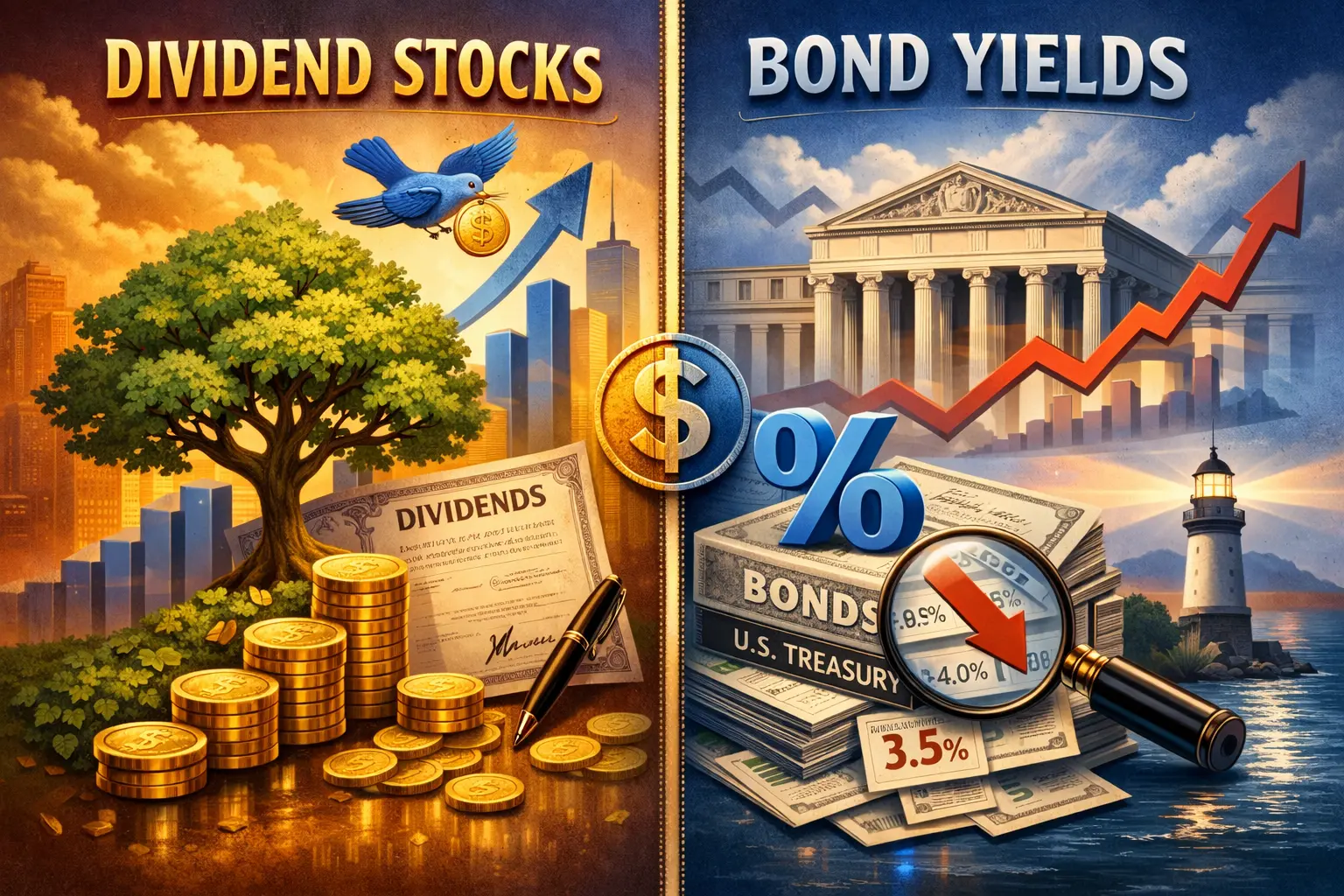
For a decade of near-zero rates this question barely existed: bonds paid almost nothing, so dividend stocks won by default. With the 10-year Treasury now above 5% (5.22% on 8 October 2026), the comparison is sharper than it has been in years.
The short answer: a bond pays you a fixed coupon and gives your money back; a dividend-growth stock starts with a lower yield that can grow every year, plus the chance (and risk) of the share price moving. Every dividend decision is secretly a bond decision, because the 10-year Treasury yield is the hurdle rate: it is what the market pays you for taking almost no risk. When the 10Y pays 5.2%, a 3%-yielding stock is only worth owning if its growth closes a gap of more than two points - and when the 10Y pays 1%, almost any safe dividend looks brilliant.
This guide walks the trade-off with a worked 10-year example, the companies with the longest dividend-raising streaks, and the sector effects you can watch live on the free dashboard: the 10-year Treasury yield, the yield curve, and the bond-proxy sectors in the Sector Heatmap.
Educational only, not financial advice. Companies are examples, not recommendations. Bond yields are from FRED as of 8 October 2026; company yields and streak counts are approximate as of mid-2026.
Yield comparison: the trade-off in one table
| 10-Year Treasury | Dividend-growth stock | |
|---|---|---|
| Income | Fixed coupon, known to the cent for 10 years | Starts lower, can grow every year (or be cut) |
| Principal | Returned in full at maturity (if held to maturity) | Whatever the market says that day - up or down |
| Inflation | Coupon's buying power shrinks every year | Growing dividends can outpace inflation |
| Risk | Near-zero default risk (US government) | Full equity risk: price swings, dividend cuts |
| Taxes (US) | Interest taxed as ordinary income | Qualified dividends taxed at lower capital-gains rates |
| Best when | Yields are high and you need certainty | You have time, and the company keeps raising |
The whole argument compresses into one question: is the growth worth the risk premium? The wider the gap between a stock's yield and the Treasury's, the more work growth has to do.
The middle of the spectrum: corporate bonds and CLO funds
The Treasury is the clean benchmark, but it is not the only bond. Between the risk-free coupon and the dividend stock sits a whole spectrum of income that this comparison should acknowledge:
| Income source | Yield (8 October 2026) | What you are taking on |
|---|---|---|
| 10Y Treasury | 5.2% | Only rate risk; coupon and principal guaranteed |
| Investment-grade corporate bond funds (e.g. LQD) | ~5.9% | Credit spread risk, but spread across hundreds to thousands of issuers - far less single-name risk than most people assume |
| AAA CLO funds (e.g. JAAA) | ~5%, floating | Floating-rate senior tranches that pay short-term rates (SOFR, 3.9%) plus a spread; AAA CLO tranches have a historical default record near zero, and floating rates mean almost no duration risk - but the income FALLS when the Fed cuts, and the instruments are newer and less liquid |
| High-yield ("junk") bond funds (e.g. HYG) | ~8.1% | Real credit risk; behaves half like a stock in a selloff |
| Dividend-growth stocks | ~2-4.5% growing | Full equity risk, but the only option on this list whose income is designed to rise |
Treasury, corporate and high-yield figures are FRED series DGS10 (5.22%), the ICE BofA US Corporate Index effective yield (5.94%) and the ICE BofA US High Yield Index effective yield (8.11%), all for 8 October 2026; fund yields differ a little from their index. The CLO figure is our estimate from SOFR (3.87%, FRED) plus a typical AAA spread. Dividend-growth yields are approximate.
The honest takeaway: diversified corporate funds pay meaningfully more than Treasuries, with less risk than their reputation suggests - a thousand-bond fund is not one risky bond. Floating CLO income shows the other side: with short-term rates well below the 10-year, AAA CLO funds now pay a little less than the Treasury, and they would pay less again after a cutting cycle. What none of them offer is growth: the dividend grower's payout is designed to rise through every rate cycle. Fixed (or floating) income solves today's income; dividend growth solves income twenty years from now.
Two of these, live:
- iShares Investment Grade Corporate Bond ETF LQD–
- Janus Henderson AAA CLO ETF JAAA–
Growth potential: $10,000, ten years
Take $10,000 and two honest options, at today's rates: a 10-year Treasury at 5.2%, versus a dividend grower yielding 3.0% that raises its dividend 7% every year (roughly the long-run pace of the classic dividend-growth names). Ignore price moves and reinvestment; just watch the income:
| Year | Treasury income | Stock dividend | Stock yield on cost |
|---|---|---|---|
| 1 | $520 | $300 | 3.0% |
| 3 | $520 | $343 | 3.4% |
| 5 | $520 | $393 | 3.9% |
| 8 | $520 | $482 | 4.8% |
| 9 | $520 | $515 | 5.2% |
| 10 | $520 | $552 | 5.5% |
| 10-yr total | $5,200 | ~$4,145 |
Read it honestly, both ways:
- The stock's annual income only passes the bond in year 10 ($552 against $520), when it pays 5.5% on your original cost - and it is still growing, while the coupon never will.
- But the bond wins the first decade on total income by more than $1,000 ($5,200 vs ~$4,145) and returns your $10,000 with certainty. The stock's case rests on years 11+, price appreciation, and the growth actually continuing.
- Rates move the crossing point a lot. At the 4.6% coupon of mid-2026, the same stock passed the bond in year 8; at 5.2% it takes until year 10. When the 10Y paid 1.5% (2020-2021), a 3% stock out-earned it from year 1 - which is why dividend stocks boomed then and struggled when yields normalized.
Watch the hurdle rate itself live: US 10Y yield and the Fed Funds rate are both on the dashboard.
Risk profile: a coupon is a contract, a dividend is a promise
Be honest about the risk asymmetry. A Treasury held to maturity cannot cut its coupon and cannot fail to return your principal - the US government guarantees both. A dividend stock can cut, and history says cuts cluster exactly when you least want them - in recessions, when share prices are already down (bank dividends in 2008, dozens of cuts in 2020). A dividend is a promise a board can withdraw; a coupon is a contract.
Price risk is just as asymmetric: the bond's value wobbles with rates but converges back to par at maturity, while the stock can be 30% below your entry for years even if the dividend keeps flowing. That difference is what the extra yield-plus-growth is paying you for - and why the long raising streaks in the next section matter: they are the closest thing equities have to evidence a payout survives recessions.
The proof it can work: the longest raising streaks
These are examples of companies that have raised their dividend for decades without interruption - through dot-com, 2008 and the pandemic. Streaks are facts about the past, not guarantees (companies have broken them), but they show what "dividend growth" means in practice. Approximate figures as of mid-2026:
| Company | Sector | Years raising | Yield (approx) | Character |
|---|---|---|---|---|
| Procter & Gamble (PG) | Staples | 65+ | ~2.5% | Classic King, slow and steady |
| Johnson & Johnson (JNJ) | Health Care | 60+ | ~3% | King, defensive stalwart |
| Coca-Cola (KO) | Staples | 60+ | ~3% | King, the Buffett holding |
| Lowe's (LOW) | Retail | 60+ | ~2% | King with faster growth, lower yield |
| PepsiCo (PEP) | Staples | 50+ | ~3.5% | King |
| Target (TGT) | Retail | 50+ | ~4% | King, higher yield after price weakness |
| ADP (ADP) | Business services | 50 | ~2% | Growth-tilted King |
| ExxonMobil (XOM) | Energy | 40+ | ~3.5% | Aristocrat, cyclical sector, unbroken streak |
| Chevron (CVX) | Energy | 35+ | ~4.5% | Aristocrat, higher yield |
| Realty Income (O) | Real Estate | 30+ | ~5.5% | Monthly-paying REIT, the classic bond proxy |
Illustrative examples of long dividend-growth streaks, not recommendations. Streaks can end; 3M was a Dividend King until its 2024 restructuring reset the payout.
Live prices for these names (delayed/last-traded, for context):
- Johnson & Johnson JNJ–
- Procter & Gamble PG–
- Coca-Cola KO–
- PepsiCo PEP–
- Lowe's LOW–
- Target TGT–
- ADP ADP–
- ExxonMobil XOM–
- Chevron CVX–
- Realty Income O–
Why dividend sectors trade like bonds
When Treasury yields move, three sectors move with them, in the opposite direction: Utilities (XLU), Consumer Staples (XLP) and listed Real Estate (XLRE). Their businesses grow slowly, so their appeal is the income - which makes them compete head-on with bonds. The market calls them bond proxies.
- Yields rise → the fixed coupon gets more attractive → bond proxies fall (why 2022 was brutal for REITs and utilities).
- Yields fall → income money hunts for a home → bond proxies rally (watch it whenever a rate-cut cycle begins).
- Fast dividend growers (low starting yield, high raise rate) care less about rates - their story is growth, not the current coupon.
You can watch this relationship live: open the Sector Heatmap (the Sectors chip on the dashboard) on any day the 10Y yield moves sharply and see whether Utilities, Staples and Real Estate sit at the opposite end of the map from the yield move. The mechanics of why rates move everything are in the How Interest Rates Affect the Markets guide.
The two ETF ends of this page's trade-off, live:
- Schwab US Dividend Equity ETF SCHD–
- iShares 20+ Year Treasury ETF TLT–
The tax wrinkle (US, briefly)
In US taxable accounts the comparison is not yield-for-yield: Treasury interest is taxed as ordinary income (though exempt from state tax), while qualified dividends are taxed at the lower long-term capital-gains rates (0%, 15% or 20% depending on income).
A concrete example: for an investor in the top 37% federal bracket, a 5.2% Treasury coupon leaves roughly 3.3% after federal tax, while a 4.0% qualified dividend taxed at 20% leaves about 3.2% - close to a tie, and the Treasury's exemption from state tax tips it further toward the bond. At the 4.6% coupon of mid-2026 the same comparison went the other way (2.9% against 3.2%): every rise in Treasury yields moves this line. In a low bracket the ranking can change again, and inside tax-sheltered accounts (401(k), IRA and their equivalents) the difference disappears entirely. Rules differ by country, account type and bracket - this is a factor to know about, not tax advice.
Outside the US the mechanics are different again, and the first cut happens before you ever see the money: dividends are withheld once on the way from the company to the fund and again on the way from the fund to you. For European investors that is the whole story behind why UCITS ETFs are domiciled in Ireland, and behind whether an accumulating share class defers anything at all.
The bottom line
The choice between dividend stocks and bonds is a trade between growth, stability and your tolerance for risk. Bonds win on certainty: a contractual coupon and your principal back. Dividend growers win on time: an income that compounds past the coupon (in year 10 in our example, with the 10Y at 5.2%) and keeps climbing, if the growth holds and you can sit through the price swings. The higher the 10-year Treasury yield, the stronger the bond's case; the longer your horizon, the stronger the stock's. Most income investors end up owning some of both - and watching the 10Y yield to know which side the market currently favors.
Common questions
Are dividend stocks better than bonds?
Neither is better in general. Bonds give certainty: a fixed coupon and your principal back. Dividend growers give a rising income and equity upside, at equity risk. The 10Y Treasury yield is the hurdle rate for the comparison.
What happens to dividend stocks when yields rise?
The bond alternative gets more attractive and future dividends are discounted harder, so high-yield slow-growers (the bond proxies) fall the most. Fast dividend growers are less rate-sensitive.
What about corporate bonds and CLO funds?
They fill the middle of the spectrum: diversified investment-grade corporate funds yield about 5.9% (October 2026) with credit risk spread across thousands of issuers, and AAA CLO funds about 5% floating with a near-zero historical default record. Corporates pay more than the 5.2% Treasury; CLOs, tied to short-term rates, now pay a little less. Neither offers growth, and floating income falls when rates are cut.
What is a good dividend yield when the 10-year Treasury pays over 5%?
There is no magic number. A stock yielding less than the Treasury has to make up the gap with dividend growth and price gains; a stock yielding far more (8% or more, as much as junk bonds pay) is often a warning that the market doubts the payout. Many dividend-growth investors focus on starting yields of 2.5% to 4.5% with a long record of raises.
What is a Dividend Aristocrat / King?
An S&P 500 company that has raised its dividend for 25+ consecutive years (Aristocrat) or 50+ years (King). A screening signal, not a guarantee - streaks have been broken.
What is yield on cost?
This year's dividend divided by the price you originally paid. It is how a 3% yield today becomes 5.5% on cost after a decade of 7% raises - the core of the dividend-growth argument.
Go deeper: the dividend-growth classics
Three books cover this ground far better than any web page:
- The Single Best Investment - Lowell Miller · the classic case for quality companies with growing dividends as a complete strategy.
- The Little Book of Big Dividends - Charles Carlson · a short, practical framework for judging whether a dividend is safe.
- Get Rich with Dividends - Marc Lichtenfeld · the yield-on-cost compounding playbook, worked in detail.
Explore the markets
Partner platforms (sponsored). We may earn a commission if you sign up. Not a recommendation or financial advice.

This guide is free to use, supported by affiliate partnerships. Some book, broker and tool links are sponsored, and we may earn a commission if you buy or sign up - at no extra cost to you. This never affects what we cover or how we explain it.

Social Sentiment - Top 15 Stocks
Social sentiment is unavailable right now.